WNMU Policy Review
Policy Review Portal
Our Commitment to Shared Governance
As part of WNMU’s commitment to shared governance, faculty, staff, and students (where applicable) are encouraged to review and provide feedback on new policies and proposed substantive changes to existing policies.
Policies are posted for public review for a minimum of 15 days, with the review period identified for each posting. Feedback submitted through the Policy Feedback Form will be provided to the appropriate Policy Owner for consideration.
Click on the sections below to view policies currently available for review.
2026–2027 Policy Review Cycle
The 2026–2027 University policy review cycle is underway. Policy Owners and Coordinators are reviewing existing policies to determine whether updates are needed.
Policies with proposed substantive changes will be posted for public review and feedback as they become available. Policies requiring no revisions or only minor administrative updates will be documented through the University’s established policy review process.
The following policies are available for public review as part of WNMU’s 2026–2027 policy review cycle. Click on a policy title below to view the proposed revisions. WNMU employees may submit comments, questions, or recommendations anonymously through the Policy Feedback Form linked above. All feedback will be provided to the appropriate Policy Owner for consideration.
- BA452 – Review of Employment File Policy – Updated language to clarify scope of policy and privacy protections.
- BA444 – Staff Emeritus Policy – Updated language for employee’s email status based on IT policy and updates to the Acceptable Use process.
- NEW POLICY: BA467 – Clean Desk & Clear Screen Policy (IT)
- NEW POLICY: BA468 – Acceptable Use of Licensed Resources (IT)
- SAEM502 – Student Disciplinary Policy Statement – Changes in disciplinary record storage, authorized access, and notification to the Registrar and Financial Aid.
- SAEM501-Felony Conviction Admissions Policy – Updated admissions review process for applicants with felony convictions, clarified responsibilities and decision-making procedures, and revised applicant notification methods.
The following policies are available for review by UPC as part of WNMU’s 2026–2027 policy review cycle. Click on a policy title below to view the proposed revisions.
- BA435 – Staff Performance Evaluation Policy
- BA437 – Nepotism in the Workplace Policy
- BA443 – Employee Conflict of Interest Policy
- BA455 – Noncompetitive Selection Policy
Policy Comments & Response
Your feedback matters. All comments submitted during the public review period are compiled, shared with the policy owner, and carefully considered before the policy moves forward through the University’s approval process. Comments are posted anonymously, along with responses from the policy owner, to promote transparency and help the University community understand how feedback is evaluated and incorporated into the policy development process.
Public comments and associated responses are provided to the appropriate review and approval bodies as the policy advances through the University’s review and approval process.
We thank all of you that have taken the time to respond.
_____________________________________________________________________________________________________________________________
| BA435 – Staff Performance Evaluation | Looks good, no suggestions, thank you.(4) | Thank you all for your feedback. |
| This looks like a good revision, but it does not specify who will conduct the performance evaluation. | Performance reviews are conducted by the supervisor the employee reports to. | |
| I like the broader areas for evaluation, as there may be issues outside of the four previously specified areas. | Thank you for your feedback. | |
| As part of the Staff performance evaluation, the process should start with an accurate or updated job description! Most job descriptions change over the years and need to be revised, but they are not. | As part of the annual review process, managers should review the job descriptions with each of their employees and contact HR when updates are required to assess if the duties are accurately representing what the position requires. | |
| What happens if the VP or the President is the supervisor and his/her evaluations are not done? Employee Services & Programs will track completion of the evaluation process and follow up with the appropriate Vice President when evaluations are not completed as required |
||
| BA437 – Nepotism in the Workplace | This is clear and concise. | Thank you for your feedback. |
| These changes seem to make this policy more inclusive. This has been an issue in my department in the past that has directly affected me. Please uphold this policy in the future. | Thank you for your feedback. | |
| The language changes make the policy and action steps clearer. | Thank you for your feedback. | |
| I like the revision if it passes. Makes it clearer and more definitive. | Thank you for your feedback. | |
| Looks good, looks fine. (3) | Thank you for your feedback. | |
| No individual should have decision-making authority or substantial influence over the hiring, work responsibilities, salary, hours, career progress, benefits or other terms and conditions of employment of a related party. Who would handle the salary when restructuring takes place when a VP or Associate VP is a family member of a person put into a higher paid position. When Business Affairs (BA) restructured the last time with the Exec. Directors, the pay raises given to family members was a talking point all over campus. Why does BA restructure when other divisions are told that they can’t do anything until July 1st. Mid year raises need to stop unless someone leave the university and someone is hired to fill the position. Moral killer. | Thank you for sharing your concerns. The proposed language in BA437 is intended to address situations where a related party may have direct or indirect influence over employment decisions, including compensation, promotions, and changes in job responsibilities. WNMU has implemented new review processes for organizational restructuring and position changes that include HR review and appropriate administrative approvals. These processes are intended to provide additional oversight, promote consistency in employment decisions, and identify and address potential conflicts of interest. | |
| I don’t like have personnel in same division. It causes issues when the chain of command is addressed. | ||
| BA443 – Employee Conflict of Interest | Looks fine; no suggestions. (3) | Thank you for your feedback. |
| The change in the “purpose” language is much more concise. Overall the language seems to be tightened up, but the use of “act” instead of “action” does make it a little awkward. | Thank you for your feedback. We will review it for any further action. | |
| BA455 – Noncompetitive Selection | Does this policy change/conflict with accredited program practices of voting in permanent (3-year term) Associate Deans? | This policy applies to noncompetitive hiring and employment appointments. Assignments determined through established faculty voting processes are not governed by this policy. |
| Link issues opening a different policy. (4) | All link issues were resolved upon notification; those that had issues are welcome to come back in and respond. | |
| Moral issue. Some are given jobs and have no degree, certification, etc. to do the job. Then soon they are filling the job which no qualifications. Then they are paid more than those with the experience, degree or qualifications. | Thank you for sharing your concerns. BA455 was established to provide appropriate checks and balances when considering exceptions to the competitive hiring process. Noncompetitive selections require documented justification and appropriate approvals, and candidates must still meet the established minimum qualifications for the position to be considered. | |
| Can’t have only an “A”. Use bullet points or just indent. | We’ll look at the grammar and correct if appropriate. Thank you for your feedback. | |
| CC606 – Web Page Development Policy | I am glad there were additions made about this policy and AI at WNMU. | Thank you for your feedback. |
| Appreciate the clarification on AI use! | Thank you for your feedback. | |
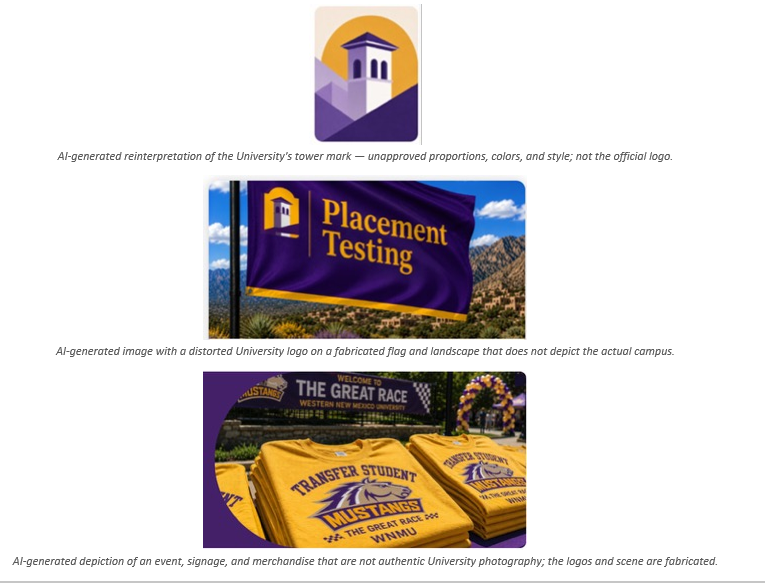
| While the AI generated code policy makes sense due to secutrity risks, the AI generated images part of the policy is overly-restrictive without reasonable justification. The policy requires the use of images produced only through marketing. Marketing and the web team have both been slow to respond to requests, and tend to pick and choose which requests are actually completed. They do not give rationale for what they prioritize and they typically ignore requests they do not wish to support. The available images do not provide an adequate selection for all possible needs for every web page within the university. This policy appears to be targeted at certain pages within the website and an effort to maintain control without actually putting in the work to produce a modern, high-quality web page. The result of the web redesign is a text dominated clunky website that belongs in the AOL era for all but a few select pages. It seems to serve mainly prospective students and not current students. | We are revising the AI-generated images section so that it clearly targets only AI imagery that depicts, or could be mistaken for, real elements of the institution — logos, campus buildings and locations, people, or events. That is the real risk, because generative tools can fabricate authentic-looking things that do not exist and misrepresent the university. The revised language will explicitly allow AI for purely decorative or abstract graphics that do not depict the university or its brand.
We are keeping the accessibility standards behind the policy, because as a public institution Western New Mexico University must meet Title II of the Americans with Disabilities Act. On selection and turnaround: the Web Development team is building, in collaboration with Marcomm, a searchable WNMU image library open to all WNMU stakeholders for use on the website and elsewhere, and requests submitted through the project request forms are tracked so we can respond promptly and keep a record of what will be done. If that process has not worked well for you, please tell us the specifics so we can fix it. On the site reading as text-heavy: that usually comes from how a page’s content is organized and which components are used, not from the redesign itself — the theme includes many layout components (cards, image rows, sliders, featured links, accordions, and more) meant to create visual, student-focused pages. The Web Development team is glad to help any department restructure content and pages on their websites where the resulting web content presentation is less than ideal. See Examples |
|
| BA452 Review of Employment File Policy | might need a timeframe here; two week, a month, etc. “reasonable period of time”, | Thank you for your feedback. |
| BA444 Staff Emeritus Policy | Why can’t they keep their existing email address? Make no sense to have another one created. Some of us deal with state business and they have our addresses on file, so if we leave the university, they won’t get our auto replies saying we are no longer with the university and whom to contact for the information requested. What about cultural affairs tickets? | Pepending response |
| NEW POLICY: BA468 – Acceptable Use of Licensed Resources Policy (IT) | This is not stated for Emeritus staff in the policy above. I think we should be able to have both the staff and faculty emeritus receiptant grant the same things. Staff don’t get fees waived for using tables and chair and university rooms like one faculty member who uses locations on campus without charge because she is a faculty emeritus and was granted a fee waiver by the former president. | Pending response |